By the design team at The Display Boxes ·
Why does size matter so much on a counter?
Counter space is the smallest and most valuable space in a shop. A display that is a few centimetres too wide pushes against the card machine; one that is too tall blocks the view of the assistant or hits a shelf above. Shop owners make a quick judgement, and a display that does not fit is moved, hidden or returned.
Size also affects how the display sells. Too much room and packs lean and look sparse; too little and they jam and get damaged when someone pulls one out.
The good news is that sizing is not guesswork. With a handful of measurements and a few decisions about layout, a display can be drawn that fits the product snugly and the counter comfortably.
Where do you start?
With a single pack. Everything else is built from it. Measure the width, depth and height of one pack in millimetres, in the position it will stand in the display. If packs vary slightly, as handmade products often do, measure several and use the largest.
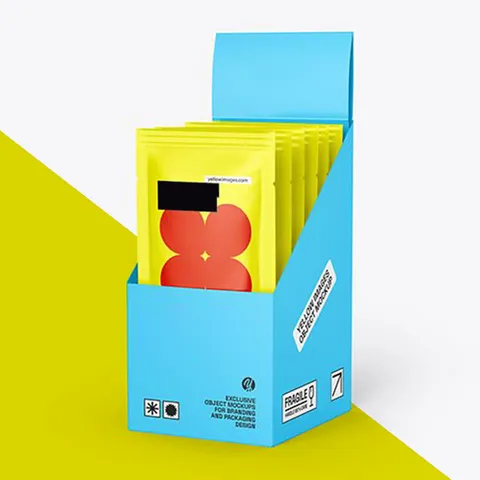
Then decide whether the pack will stand upright, lie flat, or lean back at an angle. Standing shows the front face and saves width; lying shows the top and saves height; leaning is a compromise that suits flat packs such as sachets.
Measure with the pack exactly as it will be sold: with its lid, cap, hang tab or label. A balm stick measured without its cap, or a jar without its lid, will not fit a slot sized to the bare product.
How many packs should the display hold?
Enough to look full and sell through in a sensible time, not so many that the display is half empty for weeks. For most impulse products in small shops, between one and three dozen is about right. Shops that sell your product quickly can take more.
Think also about how the shop refills it. If the display holds exactly one outer case, staff refill it in one go and know when to reorder.
- Fast sellers in busy shops: larger displays, two or three rows.
- New products: a smaller display that looks full with fewer packs.
- Several flavours: one lane per flavour, with dividers.
- Expensive items: fewer packs, more space around each one.
A display that looks crowded is as off putting as one that looks empty. Leave a little breathing space around the edges and between lanes.
How do rows and facings work?
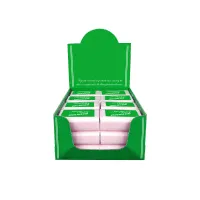
A facing is one pack visible at the front. A row is a line of packs one behind the other. A display with four facings and three deep holds twelve packs and shows four to the shopper. More facings show more variety; more depth holds more stock without taking more width.
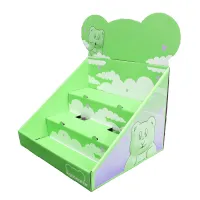
On a narrow counter, two or three facings with a stepped back row often works better than one wide row. Steps lift the back packs so they are seen over the front ones.
| Layout | Shows | Best for |
|---|---|---|
| One row, many facings | Every pack at once | Wide counters, many flavours |
| Several rows, flat | Front row only | Deep counters, one product |
| Stepped rows | Every row | Narrow counters, small packs |
| Slots in a tray | Every item from above | Round items, jars, sticks |
A useful habit is to sketch the layout from above on paper, one square per pack. It quickly shows whether the display will be long and thin or short and deep, and which shape suits the counter.
How high should the front lip be?
The front lip holds the packs in and carries a strip of print. Too high and it hides the product; too low and packs slide out when the display is nudged. For upright packs, a lip around a quarter of the pack height works well. For leaning packs such as sachets, a slightly higher lip stops them slumping forward.
The lip is also where the product name or flavour goes, so it must be tall enough to print on legibly.
If you print a price or offer on the lip, check that it stays readable when the front packs are in place, since product tops can hide the upper part of the lip.
How tall should the header be?
The header is the sign. It needs to clear the packs so it is not hidden, and to be large enough for the logo and one message. A common starting point is a header that rises about as high again above the packs as the packs themselves. Check the space above the counter first: shelves, gantries and screens often limit it.
For more on what goes on that header, read header card design tips.
A header that is too tall is just as much of a problem as one that is too short. Very tall headers catch on bags, get bent, and are sometimes folded down by staff, so keep it in proportion to the space.
How do you check the counter space?
If the display goes to many shops, design for the smallest counter you expect.
- Ask the shop for the space they can give, or measure a typical till area yourself.
- Note the width, depth and any height limit from above.
- Allow room for the card machine, bags and anything else that lives there.
- Compare the display's outer size on our proof with that space.
- If it is tight, add a tier instead of making the display wider.
What clearance do packs need?
A little. We add a small allowance around each pack so it slides in and out easily without leaning. Too much clearance lets packs rattle and tip; too little makes them jam and tear. For glass and rigid items we keep the fit snug and add an insert. For soft packs we allow a touch more room so they are not crushed.
Clearance also matters for the person refilling the display. If new stock has to be forced in, it will not be refilled neatly, and a display that looks messy sells less.
What about weight?
A full display should be easy to lift with one hand so staff can move it when they clean. If your packs are heavy, such as jars or tins, the display needs a stronger base and may be better with fewer packs on show and more stock kept behind the counter. Tell us the weight of one pack and we check the full display is manageable.
Heavy displays also need a wider base to stay stable as the front packs are removed. We set the footprint and the board together so the display does not tip forward when it is nearly empty.
What should you send us?
The size of one pack, how it should stand, the number on show and in how many rows, the counter space if you know it, and the quantity of displays. With that, we email a price within one working day and draw a free proof at full size. Print the proof, stand your packs on it and you will know at once if the size is right.
Every style starts from £0.25 a box, and after you approve the proof, production takes 5 to 7 working days.
If you only have a rough idea, send it anyway. We are happy to suggest a layout and size on the first proof and refine it with you.